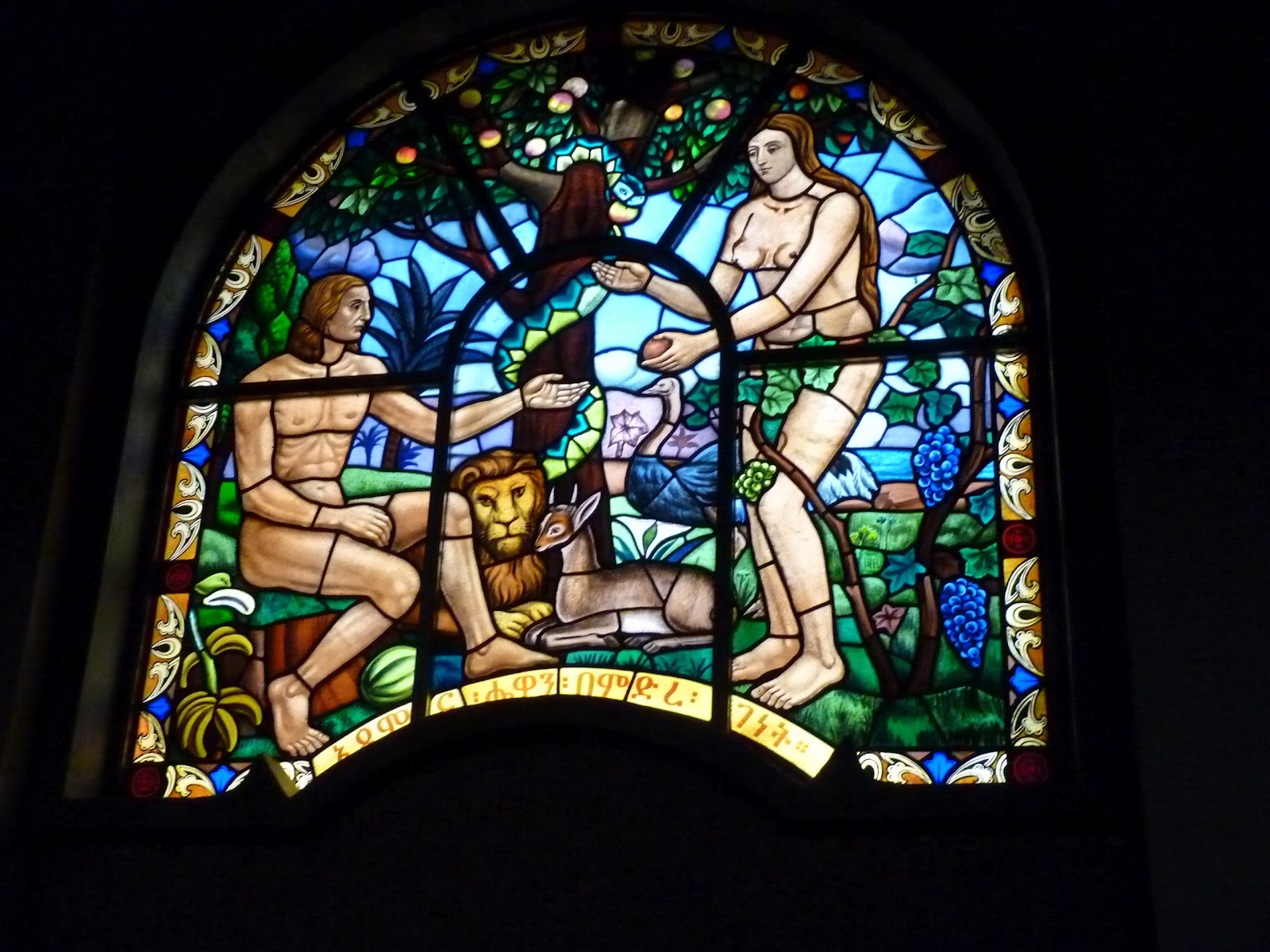
Sunday April 22, 2012
NORTH TO BAHIR DAR AND GONDAR, ETHIOPIA
This was a very full day starting by waking up at 2am, so definitely well and truly ready downstairs for our 5 am pickup for the 10 minute drive to the airport - domestic terminal, for the 1 hour flight north to the town of Bahir Dar on Lake Tana. This is the largest lake in Ethiopia and the start of the Blue Nile.
The distance is about 33km but a 10 hour drive on good roads since it is through the Highlands of Ethiopia, lots of ups and downs and switchbacks. Our driver Adane, and small bus, had driven up yesterday so he would be there when we arrived. The Airport checkin was very busy and from our perspective somewhat disorderly. All luggage (and us) had to be scanned on entrance to the terminal. Then a long line for the Ethiopian AirLines checkin counters. But various folks are pulled out of the line (they were late arriving for their flight, or group checkins of 7 or more passengers) so it was 6 am before we were checked in - and ready for the next security check and passport control.
But we were soon enjoying a very strong Italian style coffee (remember they invaded from 1936 - 1941) and left a Cimbali coffee machine in almost every establishment it seems! Mind you - the traditional brewed Ethiopian coffee - served in tiny delicate cups, and drunk sitting on low hassock or stretched skin stools, is served everywhere as well, including in the lobby at the Hilton and here in the Airport domestic terminal. Our guide Malcolm ordered double shots for the 4 of us and a single shot for himself - so we should be buzzing all day long! We all ordered chocolate muffins except for Terry who ordered a huge piece of fancy chocolate cake - his justification being that he had no supper the night before! The muffin was served warm but as I broke the first piece off to eat the entire muffin exploded across the table in a million pieces - just a little dry!
We were about 30 minutes late leaving on the prop Bombardier plane to Bahir Dar - yup, Ethiopian have several Canadian Built Bombardier planes in their fleet! As we gained altitude we could see the mist in all the valleys which are all covered in eucalyptus forests (imported from Australia years ago and growing like a weed in Ethiopia) - a result of the hot temperatures in the day, the cold night air, the “small rains” March through April each year, and we’d had a few rain showers yesterday afternoon - all combined with the high altitude of Ethiopia in general - Addis Ababa sits at 2400 metres (around 8000 feet) above sea level. So the views were spectacular and quite soft and dreamlike. The scenes below quickly turned drier and long valleys and hills as we headed North. There were signs of civilization and lots of homes the entire way - and with a population of 85 million in Ethiopia, you can see why. 40% of the population is Muslim, 50% is Christian (Ethiopian Orthodox) and the remaining 10% are traditional Animistic. They intermarry and live together peacefully.
After just a few days here of listening and seeing, we have come to realize that Ethiopia is doing well - the living standards are better than many places we have seen in Kenya, the government is working at raising the standard of living (lots of new apartments are being built). There is a strong push on family planning education to reduce the exploding population growth - we hear that this is a country where the majority of the youth and young adults feel very positive about their futures.
One hour later when we landed at Bahir Dar - the scenery outside was very dry, sunny and hot and the altitude, at 1830 m above sea level, a little lower than Addis Ababa . There was a haze everywhere over Lake Tana due to the moisture and heat in the air. We walked across the uneven rocky ground to the baggage pick up area where we waited outside while the baggage was loaded from the plane onto the luggage cart, pulled over by motor to this building ( a tin shack) with a small automated single carousel! We actually stood next to our bags on the cart but had to wait for it to be offloaded onto the baggage belt and then go inside to pick it up!
A few feet away there were several taxis and small tour buses waiting to pick up the mostly arriving tourists. There were also Tuk Tuks (the 3 wheel small taxis in Thailand) called bajaj in Ethiopia - we would see many of these, a main way of transportation here in Bahir Dar - all imported from China and India. There were at least two tour groups on our plane - one with maybe 17 folks in their 60‘s and 70‘s. Our driver, Adane, was waiting with a big smile and we were soon off, the 4 of us plus Malcolm in a 20 seater bus! Bahir Dar city of some 200,000 was designed by a German Architect in the 19th century and it surprised us - incredibly wide streets, divided by a median with flowering oleander and other shrubs - massive palm date trees lining the sides - such a wide open and welcoming feeling. Lake Tana is a major reason for coming here and the obvious signs of new construction everywhere was quite evident, especially large hotels.
We drove through the town centre to a boat dock on Lake Tana where at 9:15 am we boarded a very new and comfortable 7 seater pontoon flat deck style lake boat. Walking down the boat ramp we were approached by a souvenir vendor trying to sell us miniature straw tankwa - these are the flat papyrus boats that the locals have always used to cross the lake, which would take about 6 hours in a tankwa. These are almost identical to the straw boats that we saw on the west coast of Peru several years ago. Lake Tana averages about 9 metres deep but ranges from 1 to 70 metres so if it gets windy the waves can become quite large since it is 3600 sq km, approximately 90 km by 40 km.
The main reason for tourists coming here apart from the beautiful scenery and lake, is the Ethiopian Orthodox monasteries - there are 20 of them in the area, built on the 37 islands and the peninsula in the 14th century AD!! The architectural style is the same at all of them - a circular building with bamboo, straw and mud walls and straw ceiling. Today we were going to visit two of them - the Ura Kidanemihret and the Azwa Mariam. One of the main reasons they are so popular is the fantastic paintings and murals inside them - each monastery painted the same by the monks, deacons and bishops of the time and yesterday we had seen photos of the artwork in the Museum in Addis Ababa. On the approximately 30 minute ride across Lake Tana we saw Fish Eagle, very large red and white pelicans, Egyptian geese, and lucky enough to see two tankwa papyrus boats loaded with straw being rowed across the lake by two locals putting lots of muscle into the rowing! They also use these tankwa for transporting wood from the peninsula to Bahir Dar which is used for cooking - unbelievable when you realize that ebony and mahogany are among the hard woods used for cooking with!
When we docked at the peninsula, there were a couple of other small tourist boats there and a larger local boat which turned out to be a ferry. At the land end of the dock there was a bamboo fence and behind was a huge number of locals eager to get on to the dock and on the ferry! This was Sunday and they wanted to go into town! They made way for us to walk through and start the rocky dusty 25 minute walk uphill to the Ura Kidanemihret Monastery. Many locals were at the lake’s edge filling up the interminable yellow plastic containers with water - Malcolm told us they told us they don’t drink the Lake Tana water, just use it for washing. It was a hot but a pleasant enough walk - we heard and saw yellow fronted parrots, black and white plantain eater, and doves, and beautiful yellow ad green Senegal bee eaters. Vervet monkeys live in the forest here but we didn’t see any on our walk. Malcolm knows his birds species and bird songs very well, and also discussed much of the natural bushes and plants, explaining their traditional and current medical uses. There is a massive tree on the trail called an elephant tree - I must find out what its’ scientific name is - but it sure was huge!
Along the path were several locals setting up souvenir tables (made from bamboo) they all had the same items including cotton scarves, silver crosses, some amber and silver jewellery, and tiny replica tankwa papyrus boats. There was one artist painting copies of the art in the monasteries using nothing but the local dyes made from the earth, leaves, berries etc. He had a head of rasta locks but in answer to my question, no, he wasn’t a Rastafarian he just liked that hair style!
The Ethiopian flag also contains the green, yellow and red that we see in Jamaica - green at the top representing the fertility of the land, yellow for the harmony of the many different people living together in harmony, and the bottom red stripe - the patriots who have fought for Ethiopia.
Arriving at Ura Kidanemihret Monastery we passed a very large building being built with fancy architecture and using lots of big huge rocks - this is to be the museum where the important historical treasures will be kept and displayed. In front of the monastery were two large smooth oval shaped boulders hanging from a wooden frame with a few small rocks next to them. These turned out to be bells and made a beautiful noise when tapping the large rocks with the small stones. We climbed the four or five steps to the entrance, removed our shoes and then walked around inside with Malcolm explaining many of the paintings and what it represented. There are 4 entrance doors to the monastery - and each monastery wherever it is is painted the same. The North door has all the stories from the various Saints, the South door shows the flight to Egypt, the East door represents Palm Sunday, and the West door the many stories around the crucification of Jesus Christ.
The walls were built from wood, mud and straw ( a special kind of harder straw that lasts a long time used in all the buildings in Ethiopia). The paintings were in vivid colours and amazing condition - the bottom layer of the paintings had been repainted in some areas - the original paint being worn off due to the practise of every person at prayer tapping their head on the wall 3 times and touching and kissing the walls when praying. One thing we learned quickly was that all the good and honourable people in the world were painted with 2 eyes, all the bad people’s faces were painted in side profile showing only one eye. The painting style is quite simplistic but beautiful in its’ own way and unbelievable for how it stayed in such incredible condition through the centuries since these were all painted in the 17th Century when the monasteries were built. The monasteries were built to protect the treasures of the Church away from the fights and invasions at the time. We were not allowed to the visit the very centre of the monastery where each monastery keeps its’ replica of the Arc of the Covenant. This area is for the religious leaders only - the “Holy of Holies”.
We walked back down to the boat dock for a 2 minute ride to the Azwa Mariam Monastery close by, this was just a 5 minute ride. The paintings are almost exactly the same, the main reason for visiting this Monastery was because it still has the traditional bamboo and straw roof whereas the Ura Kidanemihret roof has been replaced or covered with a shiny iron roof for protection against the elements. We didn’t see any monks, priests or deacons at either monastery, just the tour guides. The priest can marry just once and have children (he cannot remarry if his wife dies - he becomes a monk: and if he dies first, his wife becomes a nun).
At the Azwa Mariam monastery we also saw the large drums carried over the shoulder and used in most services and ceremonies - unbelievably heavy to lift - made from hollowed out wood with skins on top for the drumming surface.
Around 12:15pm we had the occasional wet spray on our ride back across to Lake Tana since the wind had come up. We passed the two guys still working very hard to row their tankwa papyrus boats across the lake against the waves. Before we went back to the dock we made a slight detour to the source of the Blue Nile River as it exits Lake Tana, There are 6 streams that flow into Lake Tana, the largest of these is the Tinish Abay and is considered to be the true source of the Blue Nile. As we saw the beginning of the Blue Nile flowing out of Lake Tana we were rewarded with seeing several hippos with their eyes and ears popping up and own the water’s surface, African Fish Eagle and several other birds. The locals had what looked like rafts of straw and had then tied them together so that they could paddle backwards and forwards across the river. They waved and smiled as we took photos, while continuing their energetic rowing.
Back on dry land we passed a huge round building under construction - architecturally attractive with beautiful walls made from boulders. This is to be a new restaurant for feeding the tourists when they make their monastery visits. Like I said before this area is booming with lots of construction around Lake Tana. We headed off for lunch to the KURIFTU Resort and Spa - a 2 year old property built by an Ethiopian who has returned from USA. Apparently there are many Ethiopians who moved overseas to study, or to get away from the earlier Civil War, who are now returning to their homeland. This is a relaxing modern property with a large swimming pool right on the shores of Lake Tana - two level cottages with balconies overlooking the lake and all set amidst lush green flowering shrubs and grasses. The restaurant was airy, spacious with seating inside and on the front terrace outside (there are still many smoking tourists having to eat and drink outside the restaurants).
This was our first opportunity to try the local Ethiopian cuisine should we wish, and we were all up to the challenge! The food here is typically very spicy with lots of chilis and nearly every dish involves Enjera (or sometimes spelled Injera) which is like a flat pancake which is fermented and served rolled up. This is then broken into smaller pieces and used to scoop up the meal you have chosen - no utensils required. (When we asked Malcolm how often he eats Enjera it is every day, does he ever use utensils/ sometimes, for example when he eats spaghetti!) We ordered Yebeg Tibs which is roasted lamb and onions , or Yebeg Agelgel, which is lamb in spicy sauces. Well the Enjera is a grey colour and the Yebeg Tibs was grey lamb with white onions - not very appealing and no spices, definitely would not order that again. It was better when we added some of the chili sauces that had been served as dipping sauces with bread buns prior to our main course being served. Terry had Yebeg Agelgel which was lamb in a spicy red sauce which he quite enjoyed but did end up with red stained fingers afterwards! Most definitely all of us need more practise with the Enjera before we can finish a meal with hands looking as clean as Malcolm’s! We also found that the lamb (cut into small pieces) was quite chewy and often came with a piece of bone attached which made eating with fingers and the lamb inside the enjera quite a challenge. (Abay Minch is the hotel used by Dinknesh, and KURIFTU as an alternate).
It was now 2:30 and we had seen and heard so much we could hardly believe that we flew out from Addis Ababa just this morning! Time for our drive North to the town of Gondar where we would be spending the night. The road was paved all the way and in good condition, The traffic is not heavy but does carry a fair amount of heavy truck traffic heading south from Eritrea, and of course truck traffic heading North from Addis to Eritrea. There are thousands of donkeys in Ethiopia, very much beast of burden carrying heavy loads on their backs, or pulling carts, laden with people and supplies. The donkeys like to walk in the middle of the road. Lots of the Ethiopians like to walk in the middle of the road, so the horns are used frequently and we frequently wandered from side to side of the road to avoid anything that might be on it! The scenery is beautiful - rolling green hills and forests.
We had 2 well loaded big motorbikes pass us - reminding us of “Long Way Down” with Ewen McGregor and Charlie Boorman. When we mentioned this to Malcolm, he excitedly started telling us how exciting an event that had been, apparently Dinknesh Tours had provided all the support for Ewen and Charlie - meeting them at the Northern border of Ethiopia and assisting them all the way. There had been hundreds of people along the roads coming out to give their well wishes to Ewen and Charlie as they drove by, and the same for their own support vehicles as well. The Ethiopian Government had been very supportive and had laid on a big reception for Ewen and Charlie. Shortly after they had passed us, the two bikes (with a man and woman rider) were stopped on the side of the road and chatting with the crowd of locals surrounding them.
We passed rice paddies, busy village centres, lots of folks on the road sides raising their hands to try to flag down our bus for a ride, For a long stretch all the men were wearing shorts under their shirts and cotton robes - this is the fashion in this area apparently. We also heard that in areas of the country women with long hair are considered prostitutes so all the women have very short hair. In general though, very many of the women that we have seen to date have had long hair. Around 4pm we passed through the village of Addis Zemen which stands for new millenium. The drive had included significant altitude gains and by the end of the day we were around 2800 metres.
We pulled into the GOHA hotel at the very top of a switchback road (quite the driving in our bus) around 530pm and were glad to be there. We were soon checked into our rooms (reminded us both of Murchison Falls Hotel from Uganda) real stone walls, small windows, and basic bathrooms and beds (barely luke warm water when we showered that night and next morning). We exchanged rooms with Phil who had been given a room with two twin beds while we had one! The views from the hotel grounds were amazing, and out along the back terrace and then down through the gardens of the hotel we overlooked the town of Gondar and could see across to the ruins of the 17th and 18th century Royal Palaces - our adventure for tomorrow morning! Right now - it was sundowner time!
This was to be a very pleasant surprise! It was Happy Hour and it started with a laugh with the bar tender - I asked for gin and tonic and Dasher beer (the name of an Ethiopian mountain in the Simien Range)- he replied do you want “lo Cal?” I said, “Oh - you have low cal tonic?” He looked puzzled and repeated “Local gin or Gordon’s?” Ha ha ha!! English is a wonderful language!
English is taught from first year in school here in Ethiopia - so many Ethiopians speak very good English. Our tour guide Malcolm born in 1982 (his parents were both landlords with a 40 hectare farm) wanted their kids to get a good Education so Malcolm and his brothers and sisters worked very hard at school. For grades 7 & 8 there was no local school, so he had to run 15 km to school every day for two years (yes - he is still very skinny!) He wanted to be a Doctor and so studied German so that he could go to Medical School in Germany (he had a contact there and was accepted there). He was given 1 1/2 years by Leipzig University to learn German, and it took him 3 years. When he went to University in Sciences he achieved a grade of 3.6 but the government at the time decided what you were going to be trained as - and they told Malcolm he was going to be a teacher, the last thing he was interested in. So after two years he left University and went to Tourism College instead. Anyway - Malcolm’s command of English is excellent but every now and then he says a word very literally how he reads it and it can give us all a few laughs. Like when he said pluff, and we said what? and he meant plough, but he was saying plough like cough which sounds like coff - yes, English is a wonderful language! There are a very large number of Germans who come to Ethiopia and his German is very good, so quite often he will give us the German name for the Saints for example (Pedros and Johannes) versus Peter and John.
Anyway, back to Gin and Tonic. So I ordered gin and tonic, and we bought beer for Liz and Phil. When Terry paid the bill it was total 100 birr - which is about $6 and this was for 6 beers and 2 gin and tonics! The next night at the next hotel we had a 400% increase at the next night’s hotel (Simien Lodge) in Simien Mountains when it cost 400 birr (about $24) for 4 gin and tonics and 6 beer!
Another bonus is that shortly after we arrived there was going to be a wedding reception! A table had been set up for the wedding party and soon the guests arrived to welcome the bride & groom - they even had live singers right in front of us and a keyboard for music. The reception and photos lasted about 3 hours and it was fun to sit and watch the sun go down, have a sundowner on the terrace and listen to the wedding music. The music had a very Middle East sound to it, and we heard more during the trip. We saw a style of dancing by the guests that involved shaking their shoulders and leaning forward to their partners, and again we were to see more of that. We headed in for dinner around 8 pm and enjoyed vegetable rotini (especially after I had removed the hot green chilis!) followed by banana cake. We were back in the room by 9 pm Terry was asleep by 9:01 and I took a very cool shower and managed to borrow a hair dryer from the front desk before falling into bed about 10:30pm and crashed! It had been another very interesting day.
Monday April 23 GONDAR (Imperial Palace Compound) to SIMIEN MOUNTAINS
After a couple of hours on the computer on the blog, Terry walked down to the front desk at 6am to see if coffee was available anywhere - not! In fact the place was in darkness and the front desk clerk was just arriving! So we went back around 6:30 and after a breakfast of coffee, toast and marmalade and a tomato and mushroom omelette, we went outside and sat on the terrace where we could access WIFI and check our emails, along with downloading our photos - finished in time for a 5 minute look in the shop at the Ethiopian ball caps before getting on the bus at 8 am for the 10 minute ride into Gondar to drop off and see the Palace ruins. We saw coffins for sale opposite the Palaces -with the outsides covered in silver flocked red and black velvet That deserved a photo, so we walked back for photos and Terry checked out more caps, but it was our guide Malcolm who bought a new hat! When we crossed the street to the entrance to the Palaces we had to wait a few minutes since the ticket issuer was not there yet, but what a joy that was. The palaces are surrounded by gardens and beautiful very large old trees and the bird life was amazing! There are over 900 bird species in Ethiopia and we couldn’t believe how many we saw in these gardens.
They included Paradise fly catcher (blue with long white tail feathers). Africa Grey fly catcher, baglafecht weaver scraper, ground thrush, black billed vervet, abissynian
slatey flycatcher, love birds (beautiful green and yellow), black kite, Nubian woodpeckers, Eurasion hoopoe, village weaver bird, lanner falcon, white collared pigeon, olive thrush, black winged lap bird - just to name a few!
Malcolm gave us more Ethiopian history: Yeha was the oldest capital in Ethiopian history (1st - 8th century AD), from 8th - 12th century there were no known capital city and this is known as the Dark Age - during which a Jewish pagan lady, named Gudit, led the country, destructed the churches and destroyed the ancient treasures of Ethiopia. From 12th-13th century Lalibela was the capital city. From 1272 - 1974 was the Solomonic Dynasty and from 1632 - 1755 Gondar (where we were now) was the capital city and that’s when these Palaces we were about to see were built. Gondar was known for being the Coptic centre of religion, and for its’ arts and crafts. Bishops were brought down from Egypt to help preach the good word and eventually Ethiopians were sent up to train in Egypt as Bishops so that they could continue the teaching, and better yet in the Ethiopian language so the congregations could understand what was being said. From 1755 - 1855 Ethiopia had a closed door policy (no one from outside was allowed into Ethiopia with the exception of James Bruce - the explorer who found the Blue Nile (it really wasn’t Joanna Lumley from Absolutely Fab!!)
King Fasildas built the first palace here in Gondar in 1932 and it was stunning - we just stood on the grass looking at his Palace, the tall stone walls and parapets standing proud above, the sun shining magnificently on the rocky walls, and we were watching and listening to all the birds. There was just the 5 of us and it was a very special few experience!
The oldest, largest (7000 sq metres) and tallest Palace in the enclosure is King Fasildas - the one we were standing next to. The other Kings who followed Fasildas built their own Palace which were really administrative and business offices, because they all used King Fasildas Palace as their home. Much of the Palace has been restored but keeping it empty and original so that you can really get the sense of how it might have been. The rooms are large with very high walls (maybe 40 feet), even the doors were probably 20 feet tall. The original beams for the ceilings are still in place - it really was wonderful to wander around and be the only ones in the Palace. The busy time for visiting Ethiopia is October through January after the long rains when everything is green and the skies are clear, whereas at the moment the skies are very hazy. We continued walking through the other Palaces, but it was King Fasildas’ that I loved the most.
It was very warm and sunny and our always smiling driver Adane was waiting for us at the exit to drive us the short distance to the location where the Timket Festival takes place every Year (Jan 19, or Jan 20 in a leap year). This was the baths of King Fasildas but is now used once each year for the renewing Baptism Celebration where everyone (who can swim) goes to jump into the baths after the water has been blessed by the Bishop facing East. The baths (imagine a huge swimming pool about 20 feet deep) sit empty all year, but the nearby stream is guided to fill the bath each year (takes about 2 weeks to fill the baths) in time for the ceremony. After the ceremony, the water is directed back into the river. This TIMKET Festival is attended by every Ethiopian (up to 100,000 here plus many other locations throughout Ethiopia) but here in Gondar is the main event and there are 3 sets of wooden stands (seats) around the baths so that anyone who does not wish to jump into the water (including up to 5000 tourists) can also attend. In the centre of the baths is a beautiful stone walled home which was used by King Fasildas when he and his family used to visit the baths.
Again this is such a peaceful Park, lots of birds and massive fig trees - the roots from the trees growing all over and around the stone walls surrounding the baths. These giant fig trees grow only above an altitude of 2200 metres, so Ethiopia is known for many such species requiring high altitudes to prosper. Our last visit this morning was to the Debre Birhan Salassie 18th century church (rectangular design) - the name meaning Mount Light Trinity. This church is well known for all the paintings on the ceiling - and is an imitation of the oldest church to be found in Axum where the original Arc of the Covenant was stored and protected for 900 years. There are 4 entrances to the Church (just like the Trinity Church we visited in Addis Ababa on our first day in Ethiopia) North for the men, South for the women, East for the Bishop, and West for couples - the couples being allowed to enter together but must sit separately inside the church. The men sit on the Bishop’s right hand, while the women sit on the left.
Coming out of the church a blind beggar was asking for help, we gave him a few birr. We have passed quite a few people begging, mostly in Addis including the mothers holding babies, and orphan children - but traveling around the country the few people we find asking for help tend to be next to the churches and other buildings that the tourists would visit. No doubt that Ethiopia is a very religious population - most go to church at least 3 times each week, but some go every day.
On our way to what would turn out to be a wonderful lunch, the highlight of our trip so far, we stopped to check out the Taye hotel. This is the alternate hotel used by Dinknesh - 2 years old, modern, bright and clean, close to the centre of the town and right next to the Palace compound - there are a lot of stairs, no elevator so tough for older folks and those requiring more assistance. Feedback from previous clients suggest that the food and service is better at the Goha hotel - and we loved the views and peacefulness at the GOHA hotel.
Next stop was at the Four Sisters restaurant where we ate an early lunch around 11:30am - and this was indeed owned and run by 4 sisters. It is set in beautiful gardens, you feel a million miles away from the town and we sat on the deck and had a wonderful lunch including traditional foods with Enjera, and I had fried chicken with rice. I may not have mentioned before but the local food here is traditionally served on a basket with a stand (picture a cake stand) and the enjira is sitting on the flat part of the basket. Today, the lamb was served in individual crock pots with a lid on a little stand to protect the table from the heat. The lamb was still sizzling in its’ sauce in the pot when it arrived. Helen is the sister who served us with a smile - the Four Sisters was so neat and clean and such a welcoming lunch break. They also have the “coffee ceremony” set up and ready to go cooking it the traditional way over coals. When you participate in the coffee drinking, you sit on tiny little hassocks - stuffed with straw and covered in cow skin - about 24 inches high and wide. We had looked at these in the town - only 100 birr (about $6) but oh so hard to get home! The coffee ceremony takes over an hour as the lady cleans the beans, roasts them, makes the coffee (and you are expected to be polite and drink at least 3 cups!) and serves you popcorn (not sure why the popcorn). As we left the restaurant we passed a group from the UK (about 20 of them) and the buffet style meal set up for them looked amazing - Terry wanted to sit down and join them!
It was time now to depart Gondar and head 110 KM North on 70km of paved roads and 40km of dirt and gravel roads to the Simien Mountains where we would be staying for the night at the Simien Lodge - all at 3200m above sea level. We passed through the village of Weleqa where the community of Ethiopian Falasha Jews used to live but were not integrated with the rest of Ethiopia or allowed to find jobs and work to support themselves. Eventually in 1991 40,000 Ethiopian Jews were transferred to Israel by plane to find a new life. A good Jewish friend of ours from New York tells us that when the Ethiopian Jews arrived in Israel the integration with the Israelian Jews had its’ own difficulties since the Ethiopian Jews were very traditional, whereas the Israelian Jews are very much a part of the modern world and many things had changed.
The traveling is always fascinating as we look around at the countryside, and the daily activities of everyone in the villages and in the country. We passed through miles of eucalyptus forest, lots of dry and dusty rocky stretches. Most of the homes built from wood (picture large straight branches not milled 2 by 4’s!), mud and straw. Lots of kids heading home from school and we saw them for miles, the same kids in the same uniform from miles back - some of them had a very long walk to and from school each day. We stopped at Kosoye at a viewpoint for a photo stop - we were gaining altitude and the valley below was spreading beneath of us with miles of farmlands, then just above us was a massive rock pillar.
Malcolm explained about the Ethiopian famines - you may remember back in 1974 and 1988 when Ethiopia was devastated by famine due to drought and thousands of Ethiopians died. and this became a world wide issue. The population had never learned to prepare for the worst by keeping food in reserve when times were good, so when the famine hit there were no food supplies to see the population through. In addition all the young boys had been taken in for mandatory military service, so their farming families did not have enough manpower to effectively farm their own lands. Emperor Haille Selassie also refused outside assistance from the rest of the world when the famine hit. The government system at the time also required a tribute (payment of food) from every farmer, but the farmers could only pay this tribute when the rains had come - so if there was no rain there was not enough food for the farmers, and none to pay the government. The farmers did not own their lands at the time - the land ownership had been distributed by the government to a few selected people who were doing very well! After the famines this system was changed so that now everyone owns land and has been taught to plan for the future - but certainly while we have been here the small rains which come in March and April each year have been very light, the Spring is already here very early and they are talking of impending famine.
Around 3:20pm we arrived at our next World Heritage Site - the Simien Mountains National Park! At this point we had to check in with the office, pay our entry fee (90 birr per person about $5) and pick up our Park Guide Defoto and Scout Chanallo (with a rifle) which are mandatory for traveling in the Simien Park and which you have to pay for (all included with the tour price charged by Dinknesh). Defoto (about 30 years old) spoke excellent English. Chanallo (about 60 years old ) spoke none. Defoto explained much about the Park - trekking is very popular here with from 4 to 17 day treks which travel as far as Lalibela, and again the best time to trek being September through January when everything is green and the skies are crystal clear so that you can really appreciate the incredible views. 75% of the tourists come to trek, many of them from Germany. The highest Mountain is Ras Dashen (the local beer we had in Gondar was named after this mountain) and there are currently 40,000 people living in the Park The Government plans to resettle all these folks outside of the Park at some point, concerned about the population growth and impact on the Park. The Park has some endemic species found nowhere else including the Walia Ibyx, the Ethiopian Wolf, the ? antelope and Gerala Monkey. There are about 1200 plant species, 20 mammal types, 2 predators including leopards of which there are many. There are over 15,000 Gerala monkeys including one very large family of around 1500. The Gerala monkey (also known as bleeding heart due to the red patch on their chest, or Lion monkeys, due to the long fur and mane on their heads)- we were hoping to see these today! The monkeys’ diet is 99% grass (2kg per day) and 1% fleas as they groom each other. We passed a variety of shrubs and plants including the yellow flowered St John’s Wort tree, the white flowered Abyssinian Wild rose also known as the Mountain Perfume because it smells so wonderful when it blossoms.
We passed the entrance to the Simien Lodge - sitting at the highest spot right on top of the ridge - and kept on going because our hope was to see the Gerala monkeys before they disappeared for the evening - it was already after 4pm. The dirt roads were quite dusty but the views in every direction and around every corner were spectacular - all you wanted to do was look 360 degrees non stop! We came around one corner and there they were - the bleeding heart monkeys - a huge family of them all moving slowly toward the eucalyptus forest on the ridge, stopping as they went to eat grass or to sit together and groom each other! We piled out of the bus and Defoto told us we could get very close since they are not aggressive. We spent a wonderful hour with the monkeys, moving slowly along the top of the ridge with them as they moved ever closer to the forest. Their fur is so long it is really easy to see why they are nicknamed Lion Monkeys - on the big males the fur is like a big furry lion’s mane. We all took lots of photos but also spent time just watching and enjoying their activities. Eventually they had moved into the forest and we saw them start to climb down the ridge. Apparently each evening they spend on the side of the rock wall clinging with their fingers all night long to avoid capture by the leopards in the Simien Park.
The bottom of the valley here is 600 metres below and there is a village down there. We were amazed when Defoto told us that these villagers have only one way out - they climb up the sheer rock face - in places using a rope ladder of some sort on the steepest parts! He said that he could never do this himself, but more amazing - the villagers do this every time they need to come into town for supplies. So every morning around 730am if you are standing where we were right then, you would see them start to come over the ridge after climbing up the steep rock face! If they have sick villagers they tie them onto their backs and climb up the adders to bring them to the medical centre in the village (outside the park gates). What a wonderful experience this was!
But time was getting on and the sun would soon be setting, however we were about to have another wonderful experience before returning to the Simien Lodge.
Many times as we have been driving in Ethiopia, the children have run along side of us in the bus, they are always waving frantically and smiling. If they think we might be stopping they race behind us, sometimes taking a short cut, and this is what had happened. As we were driving to seek out the bleeding heart / lion monkeys - these kids knew exactly where we were heading. So they had been racing to catch up and meet us there. When we walked the hundred yards or so back down the hill about 10 kids ranging in age from about 5 to 11 years old had gathered into a small group in front of our bus - they started clapping their hands and singing. We couldn’t resist them, so we checked with our guide Malcolm with what we should give them, then we walked over to listen to them and take photos - they were all dirty with running noses but delightful. As we listened, another couple of small boys came running up and they were carrying home made wooden string instruments - a one string traditional massinko (violin) played with a bow. Well, a couple of things happened. These two looked to be about 8 years old - they arrived just as we were giving a few birr to the group to share, and Phil didn’t realise so he gave some birr to the new arrival which instantly disappeared into his pocket. So Malcolm the guide sorted that out and took it back, gave it to the oldest in the group and told him much he would have to give each of the children in the group. Once that was sorted, then the munchkin that arrived with the massinko immediately started to play, along with his buddy, and the whole group started foot tapping, clapping and then shaking their shoulders and bodies just as we had seen previously at the wedding! They were unbelievably cute and all worked so well together. We left them grudgingly, they were too cute to leave!
The short drive back to Simien Lodge with another photo stop - oh my toes curled as we stood at the top of the ridge for a photo! We checked into Simien Lodge and it was cool and windy, where we said Goodbye to Defoto and Channallo (gave them about $5 each as a gratuity). - the rooms are all individual circular design with bed and table and chair and bathroom with shower. The porters carried our bags to the room, which we very glad of - the pathway was made with large rocks and was so uneven that to walk along was difficult, there was no way to drag a bag with wheels! In addition we were now at 3300m above sea level (over 10, 800 feet) and low enough oxygen that we were puffing a little carrying just our own shoulder bags and the computer and electronics bag.
We sorted out our polar fleece, had a quick freshen up and headed down for a sundowner to watch the sun go down. The bar “AFRICA’S HIGHEST BAR” at 3300m above sea level was very nice with a large fireplace in the middle, which unfortunately they didn’t light until later but it was chilly enough that we would have appreciated it right away! We shared a local Gin and Tonic (they even have sugar free tonic here by ROYAL) but unfortunately no Happy Hour tonight! We headed in for supper of lamb and rice, not very good, mostly bone no meat! We were all very tired and in for a lovely surprise - Malcolm had arranged for hot water bottles for each of us! They were brought to us in an ice chest (cooler) and so we headed back to our rooms stumbling over the uneven path wearing headlamps but hugging our hot water bottles! Terry and I were in number 10A, the farthest from the restaurant and bar! We were scheduled for a 5 am departure the next morning for the long drive from the Simien Mountains to Axum so it was lights out and straight to bed, hugging our hot water bottle and throwing the extra blanket provided on top of the bed.